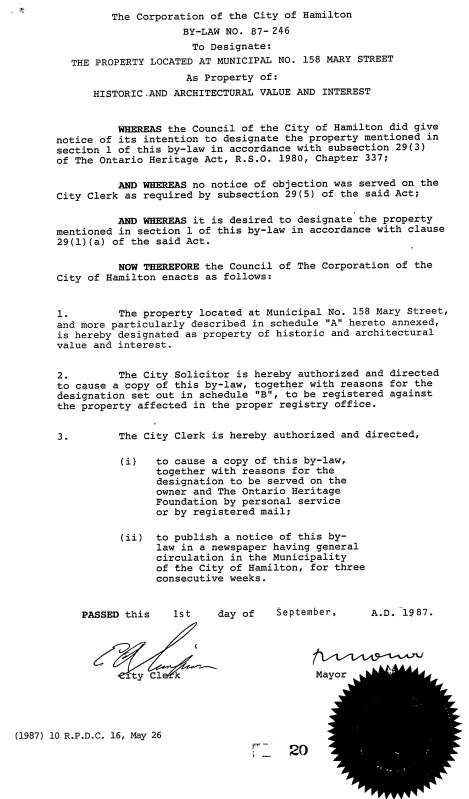
On September 1st, 1987, the Mayor of Hamilton, Bob Morrow, signed bylaw 87-246. This bylaw designated the William Pring House as a “property of historic and architectural value and interest.” The owner at the time and the Ontario Heritage Foundation were informed, and the designation was announced in the newspaper.
Congratulations, the house has a heritage designation! But what does that mean?
What is a Designation?
Professional historians and architects agreed that this house was of sufficient historical and architectural importance that it should be protected. When a property is so designated, it means that the owner is not permitted to change – and must protect – certain features, within specific parameters. Unfortunately, this protection is often sorely needed. The property listed immediately before ours in Hamilton’s directory of heritage properties, is the Century Theatre at 14 Mary Street. It was demolished in 2010 after years of neglect.
Designations do not necessarily include the whole property, and owners can often apply for permits for permission for changes. They can even unlock funding to help with restorations and repairs, if they are very lucky! A heritage designation doesn’t mean that you’re not allowed to do anything. Nor does it mean that the government will pay for everything! The owner is still pretty much on the same footing as any other property owner. There are just a few extra steps.
Historical Significance
While many important things undoubtably happened here over the course of the last 171 years, they were mostly of a personal nature, for the families who lived here. When a heritage designation is made on the basis of historical significance, it’s usually because someone famous or historically important lived there, stayed there, or did something amazing there.


Our historical significance is not huge. William Pring himself only lived here for four years, and the family sold the house in 1871. For the next several decades, the house was rented out and none of the tenants were particularly famous. The majority of the historical aspect of our designation rests on a former resident. He is recorded in the designation as Beamer W Hopkins.
Beamer’s legal first name was William, but he was known by his middle name. His father, William, owned the house from 1908 until his death in 1933 and Beamer grew up here. Beamer “had a particularly distinguished career as a politician, judge and public servant, serving at various times as alderman, controller, vice-president of the Parks Board, police commissioner and city magistrate.”
Architectural Significance
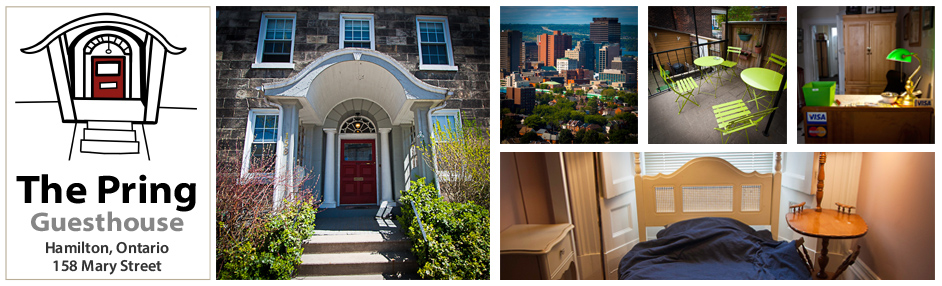
The house is on firmer footing with the architectural designation. It really is a spectacular house and we are so lucky to be its custodians. While it is not alone in Hamilton, which has many examples of beautiful 19th century stone buildings, it is on its own in this part of the city. Most of Hamilton’s “stone age” beauties are in the south west of the city, whereas we are to the north east of downtown. Most of the houses around us are brick, some clapboard, but very few are stone and there are none of this magnitude.
The limestone itself is part of the heritage designation, especially the “dressed stone front” and “coursed stone end wall.” Most particularly noted on the exterior is the “distinctive Renaissance Revival entrance, which comprises a wide doorway flanked by stone columns supporting a semi-circular voussoir and traceried fanlight.” The door and front porch, which date to the early 20th century, are specifically excluded from the designation.
Inside, there are unfortunately few original features still extant. But the features that remain are listed in the designation: “an elegantly proportioned spiral wooden staircase and the two rounded corners of the dining room with their curved panelled doors.” While the doors are mentioned, they are not specifically protected, while the staircase is.


Recent Comments